Stress-Free Charades Generator for Shy Players: Low-Pressure Visual Games
Does the thought of performing in front of a room full of people make you break into a cold sweat? You are certainly not alone. For many, the classic game of charades feels more like an interrogation than a party activity. The pressure to be "funny" or "expressive" can trigger significant social anxiety.
Many people avoid these games because they fear being the center of attention. But what if there was a way to enjoy all the laughter of the game without the intense performance pressure? Our visual charades generator is designed specifically to help. By using image-based prompts and low-pressure rules, we make it possible for everyone to join the fun comfortably.
Introverts can absolutely enjoy charades. With the right tools and a supportive environment, the game becomes a bridge for connection rather than a source of stress. This guide looks at how visual aids and smart strategies can transform your next game night.
Understanding the Charades Challenge for Socially Anxious Players
To make a game inclusive, we first have to understand why it feels difficult for some. Traditional charades often relies on a player’s ability to think quickly under pressure. A tough word on a slip of paper can trigger brain-freeze. That sudden overwhelm? Totally normal—but visual cues prevent it.
How Visual Prompts Reduce Performance Anxiety
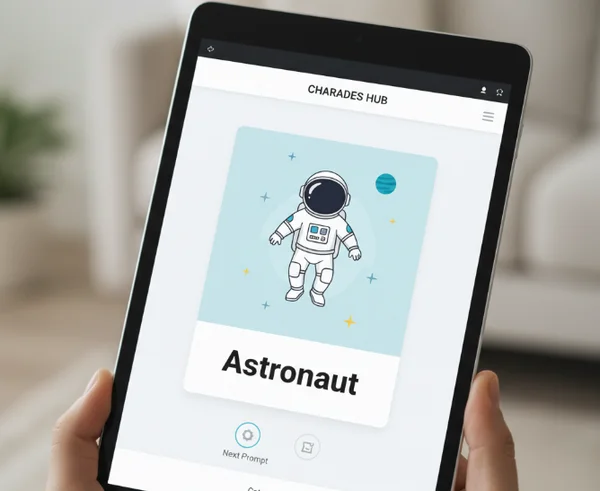
This is where technology changes the game. Our website features a unique "Powered Charades" mode. Instead of just giving you a word like "Astronaut," it can provide visual cues or dynamic images. Seeing a picture helps ground the player. It gives your brain a literal image to mimic, which bypasses the "freeze" response.
Visual prompts act as a mental map. When you see a picture of the action, your mirror neurons kick in. It becomes less about "acting" and more about "sharing what you see." Using a visual prompts tool makes it much easier to follow a guide rather than inventing gestures from scratch.
Low-Pressure Charades Strategies for Shy Players
If you are hosting a party or attending one, you don't have to follow the "old school" rules. You can adapt the game to fit the personality types in the room. Small changes in how you play can make a massive difference for introverted guests.
Common Fears That Hold People Back from Playing Charades
The most common fear is the "Fear of Being Watched." In a typical game, all eyes are on one person. For someone with social anxiety, this spotlight feels heavy. There is also the fear of "Doing it Wrong." Players worry that their gestures won't be understood, leading to a sense of failure or embarrassment.
Another major hurdle is the "Blank Brain" syndrome. This happens when the pressure to perform wipes your memory. You might know exactly what a "Penguin" looks like, but the timer causes you to forget. Having a digital safety net provides clear, instant ideas so you never feel stuck.
The Psychology Behind Low-Pressure Group Games
Psychologically, games are most effective when players enter a "flow state." This happens when the challenge matches the player's skill. For shy individuals, traditional charades sets the challenge too high. By lowering the stakes and providing visual support, we bring the game back into the "fun zone."
Low-pressure games focus on "Cooperative Play" rather than "Competitive Performance." When the goal is simply to have a laugh, the brain releases oxytocin. This lowers cortisol, the primary stress hormone. A dedicated tool ensures that the prompts are fair and age-appropriate, which removes the fear of getting an impossible word.
Silent Charades Variations Without Speaking
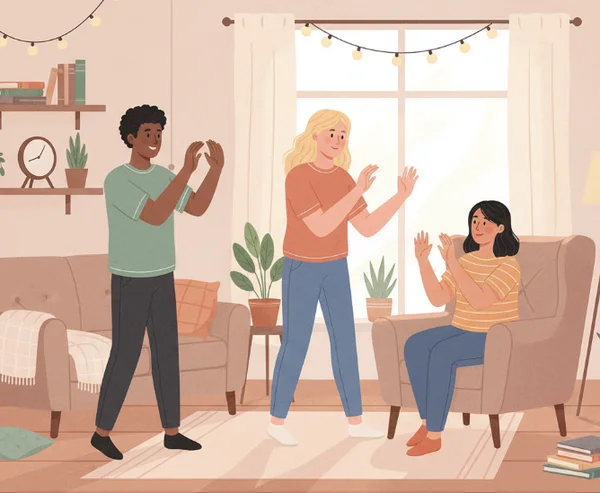
The standard rule of charades is "no talking," but we can take this further to reduce pressure. One variation is "Mirror Charades." In this version, the shy player can act out the word while a teammate stands behind them and mimics their movements. This shares the spotlight and makes the player feel like part of a duo.
Another option is "Slow-Motion Charades." Players are encouraged to move as slowly as possible. This removes the frantic energy that often causes anxiety. It turns the game into a graceful, almost meditative activity. Selecting an easy difficulty level keeps the energy light and approachable.
Our Image-Based Prompts for Non-Verbal Play
Our platform is a leader in inclusive gaming because of our content library. We offer categories specifically curated for different comfort levels. For example, the "Actions" or "Animals" categories are much easier for shy players than "Abstract Idioms" or "Obscure Movies."
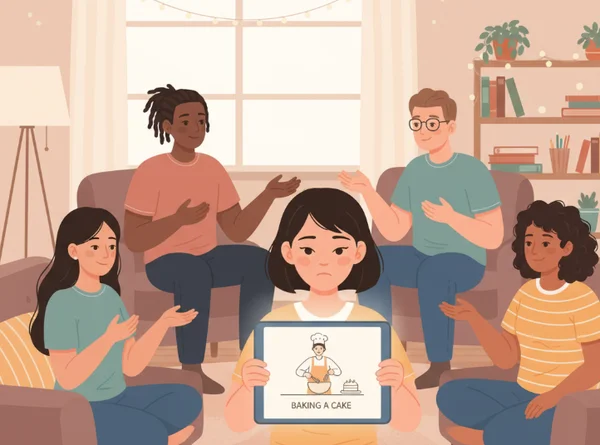
The "Powered Charades" feature provides images that help players visualize the movement. If the prompt is "Baking a Cake," seeing a quick image of someone stirring a bowl can trigger the right gestures instantly. This tool is a game-changer for those who struggle with acting on the spot.
Team-Based Approaches for Comfortable Participation
One of the best ways to protect shy players is to play in "Large Teams." Instead of one person acting for the whole group, try "Double Acting." Two people get the same word and act it out together. This immediately cuts the social pressure in half.
You can also implement a "Pass" rule. Every player gets two "Passes" where they can request a new prompt if they feel uncomfortable. Knowing that you have an "out" significantly reduces pre-game jitters. Using a random charades generator makes it easy to skip a word and get a new one in less than a second.
Creating Inclusive Game Environments for All Personality Types
A great game of charades isn't just about the words; it’s about the environment. As a host or a leader, you have the power to set a tone that makes everyone feel safe.
Setting Up a Welcoming Game Space
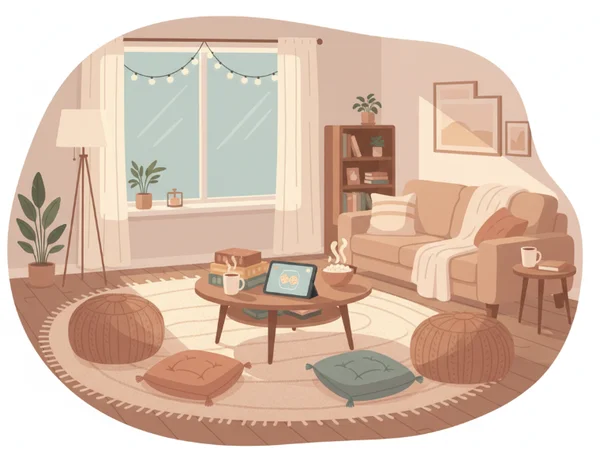
The physical setup of the room matters. Avoid a "stage" setup where one person stands in an empty space while everyone else sits in a row. Instead, sit in a circle. When the player is part of the circle, the "performer vs. audience" barrier is broken.
Soft lighting and background music can also help. A quiet, high-stakes room feels clinical and scary. A room with warm lighting and a bit of "white noise" feels cozy. Before you start, show everyone the Charades Generator on a tablet or phone so they know the tool is there to help.
Neurodiversity-Friendly Charades Adaptations
Inclusive gaming also means considering neurodiversity. Some players might have difficulty with eye contact or interpreting complex social cues. For these players, visual prompts are not just a "bonus"—they are essential.
Using clear, literal categories like "Tools" or "Sports" is often better than "Emojis" or "Feelings." Our tool allows you to filter by category, ensuring that you can tailor the experience to your group. Providing a visual reference helps bridge the gap in communication styles.
Gradual Exposure Techniques for Building Confidence
Want to ease into social gameplay? Charades acts like exposure therapy—but way more fun. Start small, and the confidence follows. In the first round, the shy player can be the timer keeper or the scorekeeper. In the second round, they can join a team of three to act out a word.
By the third round, they might feel comfortable acting out an "Easy" word solo. This gradual increase in involvement helps the brain realize the environment is safe. Practicing with a generator can help you build a "vocabulary of gestures" so you feel prepared when the time comes.
Getting Started With Visual Charades
Charades should be a source of joy, not a source of dread. By moving away from high-pressure acting and toward visual-based, supportive play, we can include everyone in the circle of fun. Whether you are using our image-based prompts or playing in pairs, the goal is the same: connection and laughter.
Don’t worry about nailing the performance—some of the most memorable moments come from hilariously botched penguin walks or over-the-top cake mixing! Our tool is here to support you every step of the way, providing endless creative prompts at the click of a button.
The Takeaway
What makes visual charades easier for shy people?
Think of visual prompts as your game-time wingman. They give you a clear starting point so you can focus on having fun instead of overthinking. When you see an image from a visual charades generator, you don't have to spend energy imagining the object. You can focus entirely on the movement.
How can I make my group more comfortable playing charades?
The best way to increase comfort is to lower the stakes. Remove the scoring system and play for fun instead. You can also allow players to work in pairs or use a tool to choose categories they are already familiar with, such as Disney movies or basic animals.
Can charades help with social anxiety over time?
Yes, it can! Charades is a form of non-verbal communication that helps people practice being seen in a safe environment. By practicing with a generator, individuals can slowly build confidence in their ability to express themselves in front of others.
What are some good charade questions for beginners?
Good beginner prompts are usually physical actions or well-known animals. Examples include "Brushing your teeth," "Playing piano," or "A monkey eating a banana." You can find thousands of these beginner-friendly ideas by visiting the Charades Generator and selecting the "Easy" difficulty level.